
Photo by Romana Correale via flickr (BY-ND)
The promise of Artificial Intelligence often conjures images of transformative efficiency, but for local businesses, that promise needs to translate into tangible, measurable benefits. Specifically, when embarking on an AI pilot project, one of the most critical metrics to track is "time saved." Measuring time saved from AI pilots is the systematic quantification of the reduction in labor hours or process duration attributable directly to the implementation of an AI solution during a trial period. It’s not just about hypothetical gains; it’s about establishing a clear, data-driven understanding of how an AI tool impacts operational workflows in a real-world, controlled environment.
This rigorous measurement is indispensable for local businesses. Unlike large enterprises with vast R&D budgets, small and medium-sized businesses (SMBs) operate with leaner resources and tighter margins. Every investment, especially in emerging technology like AI, must demonstrate a clear return. By focusing on time saved, business owners can directly link AI adoption to improved productivity, reduced operational costs, and the potential for staff to reallocate their efforts to higher-value tasks. It demystifies AI, transforming it from an abstract concept into a practical tool that directly benefits the bottom line.
Key Takeaways
- Definitive Quantifier: Measuring time saved provides a concrete, undeniable metric for AI pilot success, moving beyond anecdotal evidence.
- Strategic Justification: It offers the data needed to justify broader AI adoption and secure further investment, especially critical for SMBs.
- Operational Insight: The process reveals bottlenecks, clarifies process dependencies, and highlights areas where AI delivers the most significant operational leverage.
- Employee Impact: Understanding time savings allows for better resource allocation and can improve employee satisfaction by offloading repetitive tasks.
- Mitigates Risk: Early measurement in a pilot phase helps identify AI solutions that don't deliver expected efficiencies before full-scale deployment.
The Imperative of Pre-Deployment Baselines
Before any AI tool touches your operational workflows, establishing a robust baseline is paramount. This isn't merely a suggestion; it's the bedrock upon which all subsequent measurements of time saved will rest. Without a clear understanding of "before," any "after" becomes nebulous and indefensible.
Consider a local boutique that spends significant hours manually categorizing incoming inventory, updating product descriptions, and cross-referencing supplier invoices. To measure time saved from an AI pilot designed to automate these tasks, the boutique first needs to meticulously record the current time investment. This involves:
- Process Mapping: Documenting each step of the existing process. For inventory, this might include unpacking, manual identification, data entry into a spreadsheet or POS system, photo capture, and description writing.
- Time Tracking: Implementing a consistent method to track the duration of each sub-process. This could involve simple stopwatches, employee self-reporting logs (e.g., "Time spent on inventory processing for Lot X: 3.5 hours"), or integrated project management tools if already in use.
- Volume Quantification: Recording the volume of work processed within the tracked time. If categorizing 50 items takes 3.5 hours, the baseline is 0.07 hours per item. This per-unit metric is crucial for scalability and comparison.
- Identifying Human Touchpoints: Note where human judgment, creativity, or decision-making is genuinely required versus purely repetitive, data-entry tasks. AI is best suited for the latter (IBM AI Topics Overview: https://www.ibm.com/topics/artificial-intelligence).
For a local law firm exploring an AI tool for preliminary document review, the baseline would involve tracking the average time a paralegal spends on a specific type of contract analysis or discovery document review. For a local restaurant, it might be the hours spent by front-of-house staff manually consolidating online orders from various platforms into their POS system. The key is granularity and consistency. A baseline established over a representative period (e.g., two weeks to a month) will account for daily fluctuations and provide a more reliable average.
Practical Framework for Quantifying Time Savings
Once the baseline is firmly established, the AI pilot can commence. The measurement process during the pilot mirrors the baseline collection but focuses on the AI-augmented workflow. Here’s a step-by-step approach:
1. Define the Scope and Metrics
Clearly identify which specific tasks or sub-processes the AI is intended to optimize. Avoid trying to measure every possible impact simultaneously. For instance, if an AI is introduced to automate social media post generation, the metric isn't "overall marketing time saved," but rather "time spent drafting and scheduling social media posts per week."
2. Implement the AI Pilot with Control
Run the AI solution in a controlled environment or alongside the traditional process for a comparative period. This might involve:
- A/B Testing: One team or branch uses the AI-powered process, another uses the traditional method, processing similar volumes of work.
- Before-and-After: The most common approach, directly comparing the pilot period against the established baseline. Ensure the workload volume and complexity remain comparable.
3. Consistent Data Collection During the Pilot
Maintain the same rigorous time-tracking and volume-quantification methods used for the baseline. If employees used a specific log for manual inventory processing, they should use it for the AI-assisted process too. This consistency eliminates measurement bias.
Example: Local Bakery Order Fulfillment
- Baseline: Manager spends 2 hours/day manually consolidating online orders from their website, DoorDash, and Uber Eats into a single production sheet. (Total 10 hours/week). Processes ~150 orders/day.
- AI Pilot: Implement an AI-powered order aggregator that pulls orders from all platforms and generates a consolidated production sheet in 15 minutes, with 5 minutes of human review.
- Pilot Measurement: Manager spends 20 minutes/day on the AI-assisted process. Processes ~150 orders/day.
4. Calculate Raw Time Savings
Subtract the time spent with AI from the baseline time.
- Bakery Example:
- Baseline: 2 hours/day = 120 minutes/day
- AI Pilot: 20 minutes/day
- Daily Time Saved: 120 - 20 = 100 minutes/day (or 1 hour 40 minutes/day)
- Weekly Time Saved: 100 minutes/day * 5 days/week = 500 minutes/week (or 8 hours 20 minutes/week)
5. Factor in Quality and Accuracy
Time savings are only valuable if the quality of work is maintained or improved. A process that is faster but riddled with errors is not a true saving. During the pilot, monitor:
- Error Rates: Compare the error rate of AI-generated outputs (e.g., incorrect inventory categorization, missed order details) against the human baseline.
- Review Time: Account for any human review or correction time needed for the AI's output. In the bakery example, the 5 minutes of human review is crucial. If the AI frequently made mistakes requiring 30 minutes of correction, the net time saved would diminish.
6. Quantify Reallocated Time and Value
The true value of time saved isn't just the reduction in hours, but what those hours can now be used for.
- High-Value Tasks: The bakery manager, saving 8 hours 20 minutes a week, can now focus on menu innovation, staff training, or customer engagement – activities that directly drive revenue or improve service quality.
- Cost Savings: Translate saved hours into monetary value. If the manager’s burdened hourly rate is $40, saving 8.33 hours/week represents a potential saving or reallocation of $333.20/week.
7. Iteration and Refinement
AI pilots are iterative. The initial measurement might reveal areas where the AI can be further optimized, or where the human-AI collaboration can be streamlined. This data-driven feedback loop is vital for maximizing future time savings.
Common Mistakes and Risks to Avoid
- Ignoring Setup and Training Time: The initial investment in configuring the AI tool and training staff on its use is time-consuming. While not part of the operational time saved, it's a critical cost that must be factored into the overall ROI calculation (OECD AI Policy Observatory: https://www.oecd.org/digital/artificial-intelligence/). Don't prematurely declare an AI a failure if initial setup takes longer than expected.
- Failing to Establish a Robust Baseline: As discussed, this is the most fatal error. Without accurate "before" data, you're merely guessing at "after" improvements.
- Measuring Only Part of the Process: If an AI automates step 2 of a 5-step process but introduces new complexities or delays in steps 3 or 4, the net time savings might be negligible or even negative. Measure the entire workflow affected by the AI.
- Overlooking "Shadow IT" or Workarounds: Employees might develop their own manual workarounds if an AI solution is clunky or incomplete. This "shadow work" negates official time savings and must be identified and addressed.
- Ignoring Quality Degradation: Faster isn't always better. If the AI solution leads to more errors, customer complaints, or rework, any perceived time savings are illusory. The FTC warns against making claims about AI's benefits without sufficient substantiation, especially regarding performance and accuracy (FTC Guidance on AI Claims: https://www.ftc.gov/business-guidance/blog/2023/02/keep-your-ai-claims-check).
- Lack of Stakeholder Buy-in: If employees who perform the tasks being automated aren't involved in the pilot and measurement process, they might resist the change or provide inaccurate data, intentionally or unintentionally. Their insights are invaluable for identifying true time sinks and potential AI efficiencies (HBR AI Topics: https://hbr.org/topic/subject/ai-and-machine-learning).
- Short Pilot Duration: A pilot that's too short might not capture the full range of operational scenarios or allow for the learning curve associated with a new tool. Ensure the pilot runs long enough to provide representative data.
Checklist for Measuring Time Saved
| Action Item | Status (Y/N/NA) | Notes |
|---|---|---|
| Pre-Pilot | ||
| Clearly defined scope of AI intervention | Which specific tasks/sub-processes will AI address? | |
| Meticulously mapped current process | Document steps, dependencies, human touchpoints. | |
| Established baseline time metrics | Average time per task/unit, over a representative period. | |
| Quantified baseline work volume | Number of items processed, customers served, etc. | |
| Identified current error rates/quality metrics | Baseline for comparison post-AI. | |
| During Pilot | ||
| Consistent time tracking methodology deployed | Same tools/methods as baseline. | |
| Consistent work volume tracking | Ensure comparable workload during pilot. | |
| Monitored AI output quality/accuracy | Track errors, need for human correction. | |
| Collected feedback from pilot participants | User experience, unexpected issues, potential improvements. | |
| Tracked human review/correction time post-AI | Critical for net time savings. | |
| Post-Pilot Analysis | ||
| Calculated raw time savings | Baseline time - AI-assisted time. | |
| Adjusted for quality/error rates | Did faster mean more errors? | |
| Quantified value of reallocated time | What higher-value tasks can now be done? Monetary value? | |
| Identified unexpected benefits or drawbacks | Beyond just time savings (e.g., improved morale, new bottlenecks). | |
| Documented full cost of AI solution (incl. setup) | For ROI calculation. | |
| Prepared report with findings and recommendations | For decision-makers. |
What Should Readers Do Next?
For local business owners and managers, the next step is active engagement. Don't delegate the entire AI exploration process. Instead:
- Identify a Pilot Candidate: Look for a repetitive, time-consuming task with clear input and output, ideally one that staff finds tedious. This could be anything from scheduling social media posts, generating routine customer emails, transcribing meeting notes, or initial data entry.
- Define Your Baseline Today: Start tracking the time spent on that chosen task now. Even if you don't have an AI tool in mind yet, understanding your current operational costs is invaluable.
- Research AI Solutions: With a specific problem and baseline in hand, research AI tools designed to address that exact issue. Look for solutions tailored to SMBs, often characterized by ease of use and transparent pricing.
- Start Small and Measure Meticulously: Begin with a focused pilot, measure diligently using the framework above, and use the data to inform your decision-making.
Measuring time saved from AI pilots is not just an analytical exercise; it's a strategic imperative for local businesses navigating the AI landscape. It provides the clarity and confidence needed to invest wisely, optimize operations, and truly leverage AI for sustainable growth. This information is for general educational purposes.
Frequently Asked Questions
Q1: How do I choose the right task for an initial AI pilot focused on time savings?
A1: Select a task that is highly repetitive, consumes significant human hours, has clear, quantifiable inputs and outputs, and ideally, involves data processing rather than complex human judgment. Good candidates include data entry, preliminary document review, customer service FAQ handling, or social media content scheduling. Avoid tasks that require high creativity or nuanced interpersonal skills for your first pilot.
Q2: What if the AI pilot introduces new tasks or complexities? How do I account for that in time savings?
A2: This is critical. You must measure the entire modified workflow. If the AI automates one step but requires significant human oversight, data cleaning, or error correction in subsequent steps, those new time expenditures must be subtracted from any gross time savings. The goal is net time saved across the end-to-end process impacted by the AI.
Q3: My employees are resistant to time tracking. How can I get accurate baseline data?
A3: Transparency and communication are key. Explain that time tracking isn't about micro-managing but about understanding current processes to identify opportunities for improvement and potentially offload tedious tasks. Frame it as a way to enhance their roles, not replace them. Consider using aggregated data rather than individual performance metrics, or use passive tracking methods where appropriate (e.g., system logs for certain digital tasks). Involve employees in the process of defining what to track and how, fostering a sense of ownership.
Q4: Should I factor in the cost of the AI tool when calculating time saved?
A4: While the cost of the AI tool itself doesn't directly reduce the time spent on a task, it is absolutely essential for calculating the overall Return on Investment (ROI). Time saved translates into monetary value (e.g., reduced labor costs or increased capacity for higher-value work), and this value must be weighed against the subscription fees, implementation costs, and training expenses of the AI solution to determine true profitability.
Q5: What's the difference between "time saved" and "productivity improvement"?
A5: "Time saved" specifically refers to the reduction in the duration or labor hours required to complete a defined task or process. "Productivity improvement" is a broader term that encompasses time saved, but also includes other factors like increased output volume, enhanced quality, reduced errors, or the ability to achieve more with the same resources. While time saved is a direct contributor to productivity improvement, it's a specific, measurable component.
References
- IBM AI Topics Overview: https://www.ibm.com/topics/artificial-intelligence
- OECD AI Policy Observatory: https://www.oecd.org/digital/artificial-intelligence/
- FTC Guidance on AI Claims: https://www.ftc.gov/business-guidance/blog/2023/02/keep-your-ai-claims-check
- Harvard Business Review AI Topics: https://hbr.org/topic/subject/ai-and-machine-learning
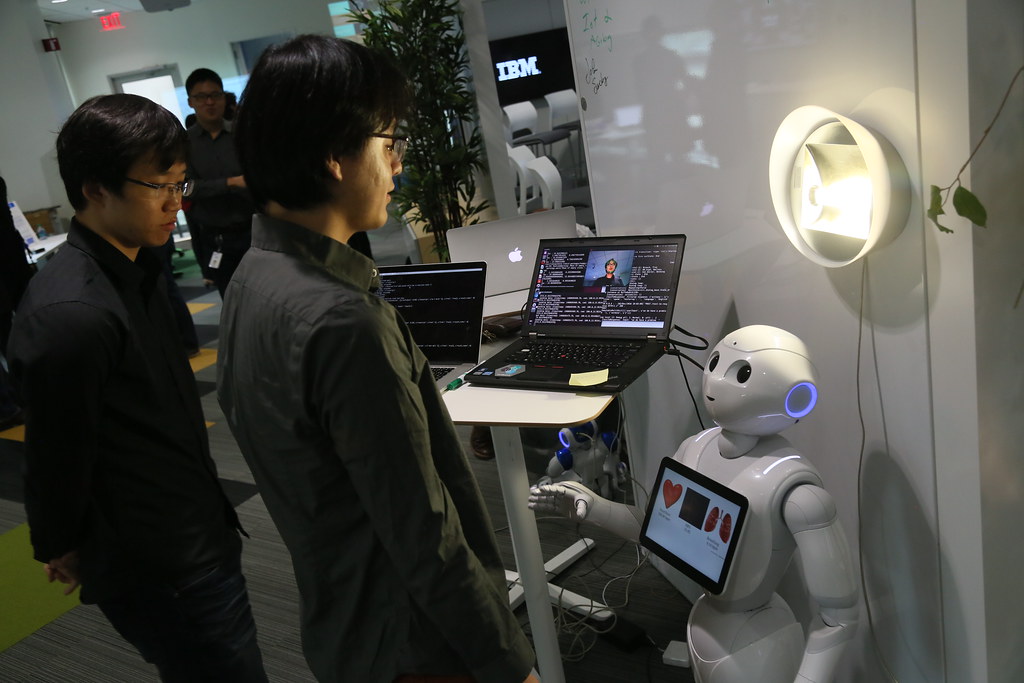
Photo by IBM Research via flickr (BY-ND)


